
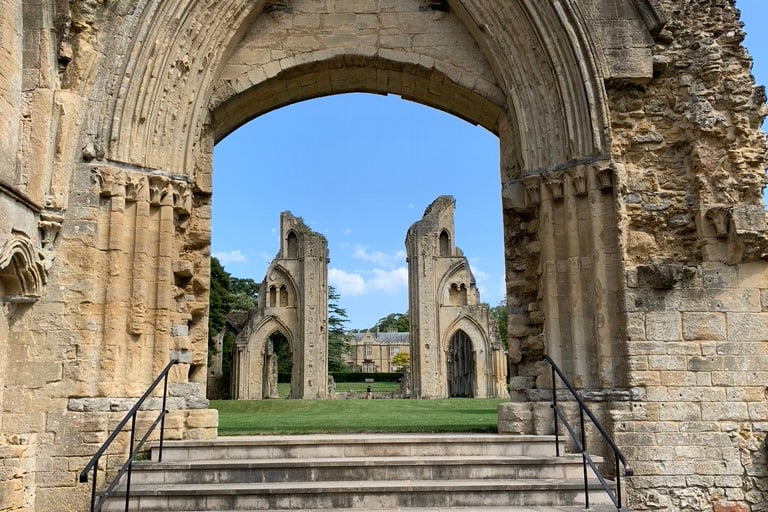
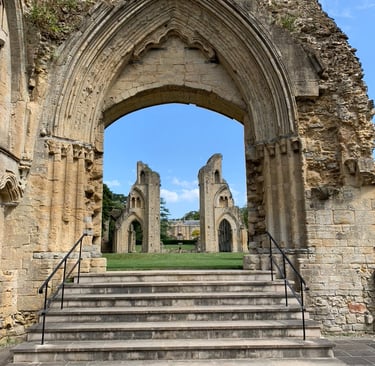
Glastonbury Abbey
Lessons from The Dragon's Echo
Mike’s experience with the monks at Glastonbury Abbey becomes his first real apprenticeship in what it means to be a guardian of wisdom, not just a witness to history. In Chapter 1, “Echoes of Destruction,” protecting knowledge stops being an abstract ideal and becomes a lived responsibility carried out in stone corridors, candlelit scriptoria, and very human acts of courage.
Knowledge as a living, fragile current
At Glastonbury, Mike discovers that knowledge is not a dead collection of texts, but a living current flowing through people, places, and time. The Abbey’s hidden chamber beneath the main library is not simply a vault; it is a crucible where ancient British lore, Christian theology, celestial calculations, and healing arts are woven into a single, fragile tapestry.
When The Shade attacks, it does not behave like a random force of destruction. Its shadows gather precisely around the secret library door, intent on severing the connecting threads that bind different traditions together. This is Mike’s first clear glimpse that some threats do not target “all knowledge,” but the specific points of connection that enable breakthroughs, synthesis, and long-term progress. He begins to see that the real risk is not mere loss, but fragmentation – a world where insights are isolated, unable to strengthen one another.
Guardianship as shared, humble service
The night at Glastonbury also reframes guardianship for Mike as a shared, often hidden vocation rather than a solitary form of heroism.
Brother Thomas, the cantor and chronicler, stands before the swirling darkness with only his keys, his cross, and his conviction that losing knowledge is “a death of the soul itself.”
Sister Agnes, moving quickly through the herb garden, carries healing lore that bridges old pagan practices with Christian frameworks, embodying the quiet continuity of practical wisdom.
These figures teach Mike that true guardians of knowledge rarely look extraordinary. They are people who copy, catalogue, tend gardens, annotate margins, and refuse to abandon their posts when it would be easier – and safer – to walk away. When Mike steps forward with the malachite scale, it is not as a lone saviour, but as someone joining an existing chain of guardianship already anchored in Glastonbury’s community.
Preservation through scattering, not hoarding
One of the most powerful lessons Mike learns at the Abbey is that to preserve knowledge, you often have to let it go. Hiding it more deeply is not enough; survival demands multiplication and movement.
After The Shade is driven back, Brother Thomas’s immediate response is not relief but action: the key manuscripts must be copied at once and dispersed to safe houses across Europe. In the scriptorium above, monks work through the night, grinding ink, preparing parchment, and setting quills to page in a disciplined, almost liturgical rhythm.
From this, three principles crystallise for Mike:
Redundancy over rarity: A single, precious copy is dangerously fragile; several copies in different places create resilience.
Action over perfection: They cannot save everything, but they work anyway, choosing what to copy under intense pressure.
Trust over control: By dispatching manuscripts outward, they give up centralised control to secure long-term survival.
This becomes a template for Mike’s own time: real stewardship of ideas means publishing, translating, and disseminating, not locking insight away in a single “safe” place.
Answering the seductive logic of forgetting
The Shade’s argument at Glastonbury is disturbingly reasonable on the surface, and that is precisely why it becomes such a critical learning point for Mike. The entity claims that dangerous knowledge brings war, suffering, and weapons, and that erasing it is a form of mercy. It frames forgetting as peace and ignorance as solace.
Witnessing Brother Thomas’s defiance, Mike recognises a pattern that echoes through history and into his own world: the most insidious censorship rarely calls itself censorship. It presents as protection, safety, or “responsible limitation.” Any claim that people will be “better off not knowing” begins to sound like the voice of The Shade.
By raising the malachite scale and standing beside Ceres, Mike chooses a different ethic: humanity must be trusted to grapple with difficult knowledge, not frozen in permanent childhood “for its own good.” The Scale’s light, which forces The Shade to retreat, symbolises truth held with courage rather than hidden out of fear.
Knowledge needs communities, not just archives
Finally, Glastonbury teaches Mike that knowledge is only truly safe when it is embodied in communities of practice, not just stored in rooms and artifacts. The secret library matters because there are monks who can read, interpret, sing, and re-copy its contents into new contexts and languages. Sister Agnes shows that wisdom also lives in hands and habits – in how herbs are grown, prepared, and administered – not only in beautiful manuscripts
For Mike, this reframes his role from passive observer to active participant:
He must help nurture people who can carry, interpret, and adapt wisdom in their own eras.
He must pay attention to “unofficial” guardians like Agnes as much as to formal custodians like Thomas.
He must accept that the work is never finished; Glastonbury is only the first of many contested thresholds where knowledge hangs in the balance.
Leaving the Abbey, Mike carries more than the memory of a nocturnal battle. He carries a new identity shaped by monks and healers who show him that to love knowledge is to copy it, share it, risk for it, and stand in the doorway when the shadows come.
Inspiration
Explore self-development and discover your potential.
Journey
© 2025. All rights reserved.
mike@mikenoelsmith.com